When people think about early childhood education, they picture story time, alphabet charts, and small chairs around even smaller tables.
What they don’t see is the systems work happening behind the scenes — the coaching, measurement, and continuous improvement that help classrooms move from basic care to true quality.
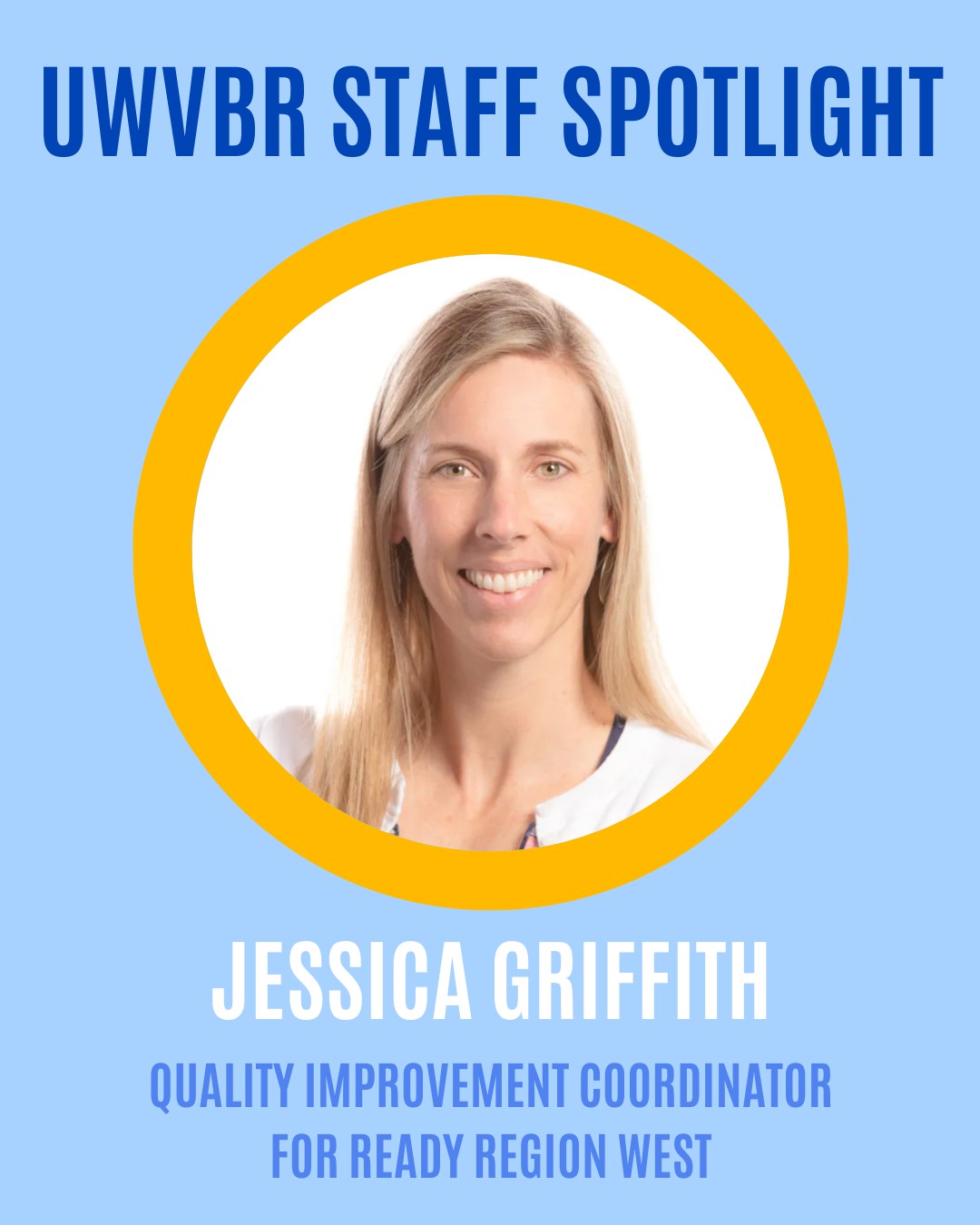
That’s where Jessica Griffith, M.Ed., comes in.
As Quality Improvement Coordinator for Ready Region West at United Way of Virginia’s Blue Ridge, Jessica has spent more than a decade helping strengthen early childhood classrooms across our region — ensuring children from birth to five aren’t just cared for, but truly prepared.
Wearing Many Hats
“I wear lots of different hats day to day,” Jessica says.
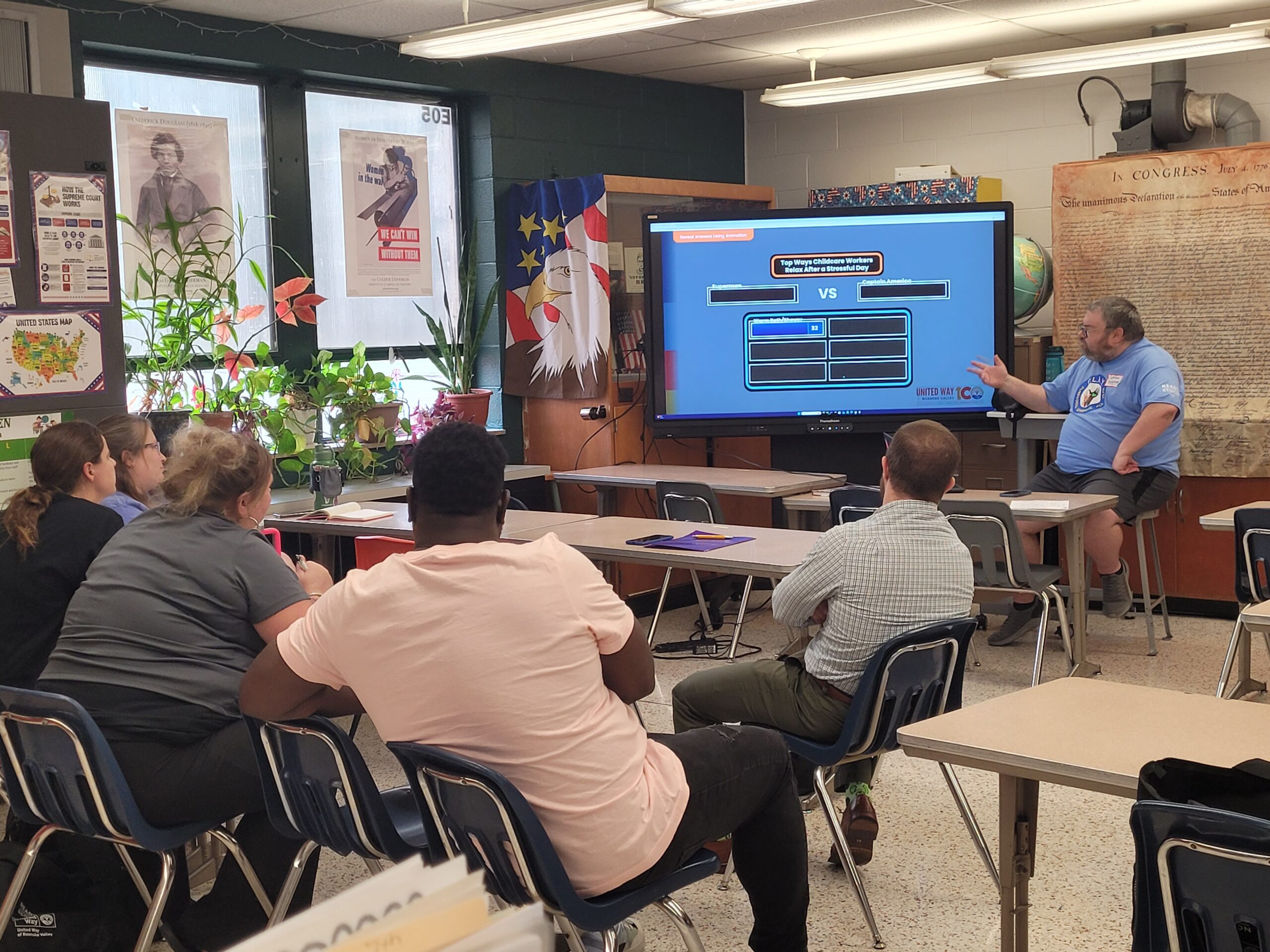
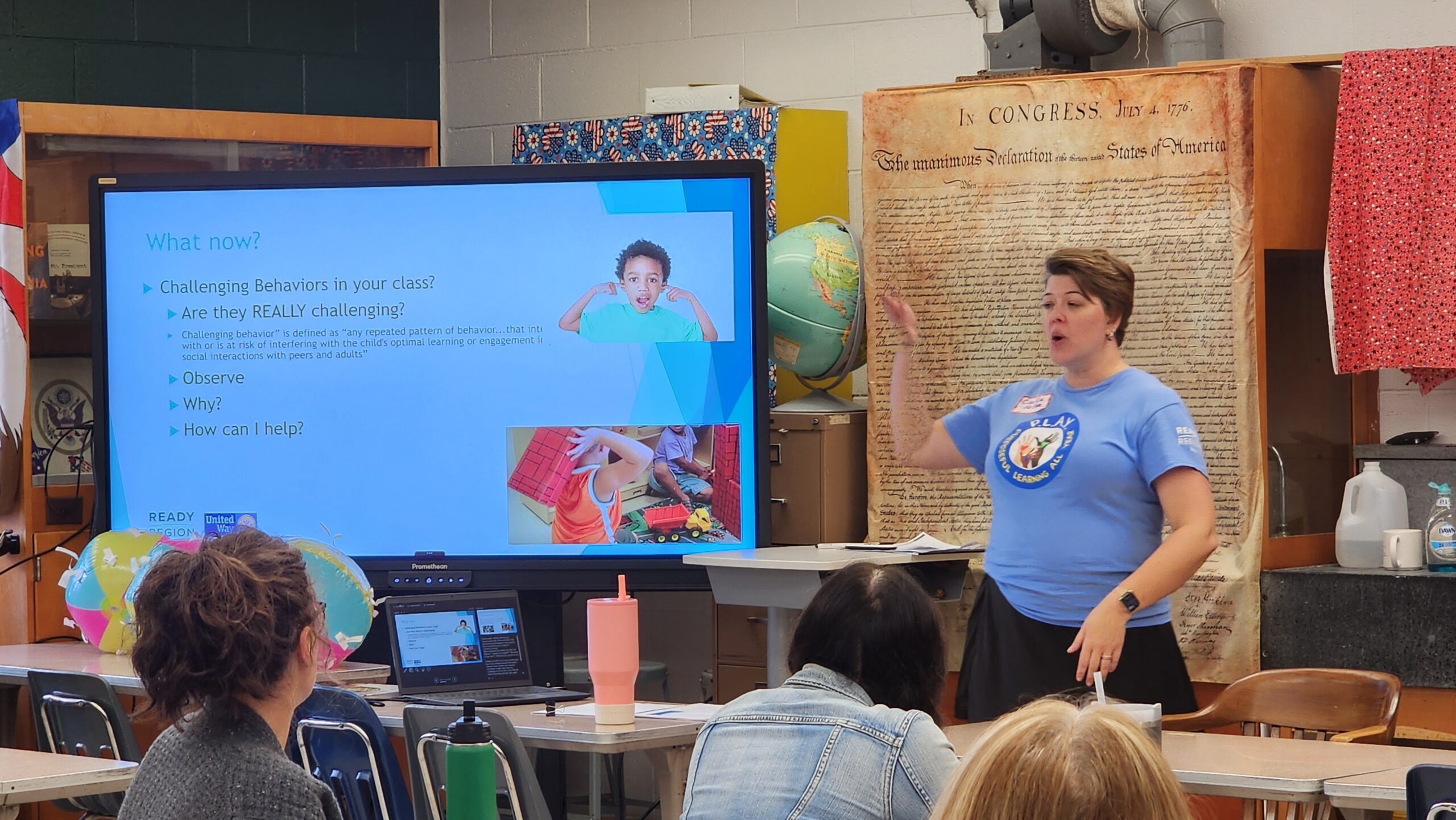
She manages a team of four Infant and Toddler Specialists who provide coaching and training to teachers across the region. She oversees grant compliance and works with state agencies. And she spends time in classrooms herself — observing, coaching, and supporting directors and teachers.
Much of her team’s work focuses on infant and toddler classrooms — where the need is often highest.
“In infant classrooms, the ratio is one adult to four children,” she explains. “But when children turn two, that shifts to one adult to eight. That’s a big difference.”
And with that difference comes one of the field’s greatest challenges: turnover.
The Reality Behind Turnover
Being alone in a room with eight two-year-olds is demanding.
“They’re not self-sufficient,” Jessica says. “Many are still in diapers. Their language skills are emerging. What parents might call ‘big behaviors’ are often developmentally typical — but managing that takes a very specialized skill set.”
Turnover isn’t just inconvenient — it’s disruptive for children.
And yet, early childhood educators in our region often earn wages comparable to entry-level service jobs.
“The average lead teacher makes around $14 an hour,” Jessica shares. “Assistant teachers are often near minimum wage. But we’re not talking about making cheeseburgers — we’re talking about children.”
Measuring What Matters
In Virginia, quality isn’t subjective.
It’s measured.
Every publicly funded birth-to-five classroom is evaluated using the same research-based tool: the Classroom Assessment Scoring System (CLASS). The tool focuses on teacher-child interactions — because research consistently shows interactions are one of the strongest predictors of child outcomes.
“In Virginia, quality isn’t just a feeling,” Jessica says. “It’s measured.”
Observations happen twice a year. From there, coaching becomes targeted and ongoing — focused on specific teaching practices and behavioral markers.
“Humans aren’t perfect, so interactions won’t be perfect,” she says. “We’re not looking for perfection. We’re looking for improvement.”
And that steady improvement adds up.
Why the First Five Years Matter
A child’s brain develops more rapidly in the first five years than at any other time in life.
“We see academic impacts through third grade,” Jessica explains. “But social and emotional development can influence someone for their entire life.”
Early investment also reduces the need for more expensive intervention later. But the long-term impact goes even further.
“We don’t even know what jobs these children will have,” she says. “They don’t exist yet.”
So the work shifts from memorization to something deeper — planting seeds for higher-order thinking, creativity, collaboration, and problem-solving.
Childcare and the Workforce
During COVID, childcare was officially marked essential — and for Jessica, that moment was significant.
“That was a light bulb moment,” she says. “If we require essential workers to go to work, we have to have somewhere for their children to go.”
Even as centers struggled to operate at half capacity, something became clear:
Childcare isn’t just an educational service. It’s a pillar of our workforce.
“Without stabilized childcare, we don’t have a stabilized workforce.”
Yet infant care in Virginia averages around $16,000 per year.
“There’s a gap between the cost of basic care and the cost of quality,” Jessica explains. “Families can’t absorb that difference alone.”
The question remains: who does?
Progress and Hope
Over the past decade, Jessica has seen meaningful change.
When she began this work, quality improvement in Virginia was voluntary. Today, programs receiving state funding are required to participate in quality measurement systems.
The shift represents more than policy — it reflects recognition.
“We see buy-in increasing,” she says. “Directors want more and better for their centers. School systems are even exploring how to carry these practices into kindergarten and beyond.”
For Jessica, the work has always been about planting seeds early.
Her commitment is professional — but also personal.
“I knew I wanted to work in early childhood from a young age,” she says. “My degree is in human development. It’s always been my passion.”
Now a parent of three, her perspective is even more grounded in the future.
“My hope is that by the time my children have children, the cost of quality will be recognized,” she says. “That we continue moving toward understanding the difference between basic care and true quality.”
Because for Jessica, this isn’t just about classroom scores.
“Providing positive early childhood experiences is preventative,” she explains. “We talk about mental health crises in our society. Setting someone up for success early in life is one of the best ways to strengthen our entire community.”
The short-term goal may be kindergarten readiness.
But the long-term goal?
A generation prepared not just for school — but for life.