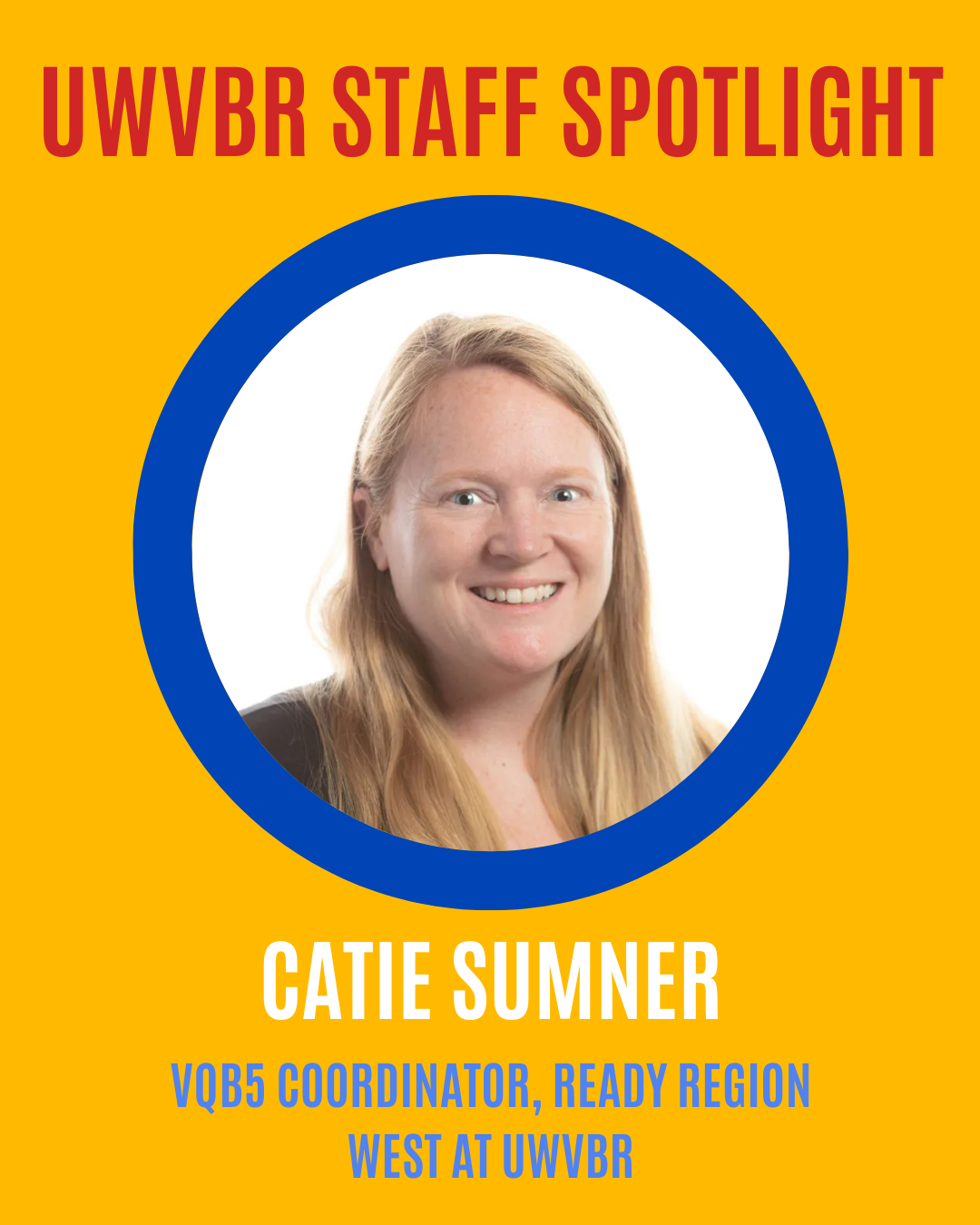
A conversation with Catie Sumner.
When families search for childcare or preschool, the questions are usually practical. Is there an open spot? Is it close to work or home? Does it fit the schedule?
What most families do not see are the systems working behind the scenes to strengthen early learning before children ever reach kindergarten. One of those systems in Virginia is called VQB5.
Many parents have never heard of it. Others may have seen the acronym but are not sure what it means or why it matters.
“There’s a lot of acronyms,” said Catie Sumner. “VQB5 coordinator… what does that mean?”
Catie serves as the VQB5 Coordinator for Ready Region West at United Way of Virginia’s Blue Ridge. In her role, she works with early education programs serving children from birth to age five and helps support Virginia’s statewide effort to measure and strengthen quality in early childhood classrooms.
Catie’s path into early childhood work
Catie’s background is in Elementary Education and Early Education from James Madison University. She also taught Pre-K in a childcare facility before moving into nonprofit work focused on community impact.
“I kind of got into community work and got a feel for the community aspect of things,” she explained. That experience included working with another United Way before joining United Way of Virginia’s Blue Ridge.
She started in Roanoke in March 2020, the same month the COVID pandemic began. At the time, the system that would become VQB5 was still developing.
“It wasn’t quite that yet,” she said. “They had the pilot program… I was hired as the preschool development grant coordinator, which was kind of the building blocks to this… working its way to the actual unified system.”
What VQB5 means
VQB5 stands for Virginia Quality Birth to Five.
Catie describes it as “the unified measurement and improvement system that the Department of Education has put into place across the state.”
In simple terms, it measures and strengthens the quality of early education classrooms serving children from birth through age five, particularly those receiving public funds.
“It’s looking at quality interactions in child care… at any facility that serves zero to five years old and receives public funds,” she said.
Why the system exists
The effort grew out of research on kindergarten readiness.
“The data… has shown the impact of early education in kindergarten readiness,” Catie said. The goal is to ensure that children are prepared for kindergarten no matter where they receive early education.
Researchers studying classrooms used a tool called CLASS, which measures interactions between teachers and children. The results showed a clear pattern.
“The higher those scores, the more prepared those children are for kindergarten and beyond.”
At its core, the system was designed to address a specific challenge.
“Children not ready for kindergarten… are specifically those who might be low income or other at risk families.”
Catie explained that early learning gaps can grow over time. Students spend their early school years learning to read, but by third grade they are expected to read in order to learn new material. When children fall behind at that stage, it becomes much harder to catch up.
Programs that participate
Programs receiving public funding participate in the VQB5 system. These include Virginia Preschool Initiative classrooms, which are typically located in public schools, Mixed Delivery programs that place publicly funded preschool slots in private childcare centers, Head Start and Early Head Start programs, and subsidy programs that help lower income families access childcare.
Although these programs operate in different settings, they share the same goal.
“The basis of this is ensuring that every child has high quality interactions,” Catie said. “Every child should have the same starting point.”
What this means for families
For many families, childcare decisions are shaped by practical realities such as location, transportation, and availability.
“Some families just don’t have a choice,” Catie explained. “They make decisions based on what’s close to their work or what’s near them.”
Limited childcare slots can also affect those decisions.
“Sometimes we don’t have enough slots,” she said. “Families find an opening and say, ‘Although it is not convenient to where we live or work, I have to put my kid there because I have to work.’”
Because of this, strengthening quality across programs is critical. The goal is to ensure children have strong early learning experiences regardless of where they receive care.
What quality looks like in early learning
Many families assume early learning is mostly about memorizing numbers or the alphabet. Research shows something different.
“A lot of families think that their children knowing one through ten and their ABCs are the most important things,” Catie says. “these things are important for children to learn. The data is showing that quality interactions, the ‘how’ we teach these things are going to be the most important for preparing our a child to learn”.”
Quality interactions can include teachers asking children how they solved a problem, helping them navigate routines and transitions, and supporting social and emotional development.
“The CLASS tool is measuring how teacher interact or respond to children having developmentally appropriate behaviors.” she explained.
Sometimes the most meaningful indicators are simple relationship signals.
“Do they laugh and smile and connect with children at a relationship level?”
Looking ahead
Catie hopes the ideas behind this system continue expanding.
“I am hopeful that this is the start,” she said, noting that the CLASS observation tool could eventually influence classrooms beyond early childhood education.
For now, the focus remains on strengthening early learning so children begin school on solid ground.
“The point is that we want everyone to understand the tool and consistently use it,” Catie said. “We have to consistently be having positive interactions.”