Why Your Donation Matters
When most people think about philanthropy, they imagine big checks from wealthy donors. But here’s the truth: the majority of gifts in the U.S. are $100 or less at a time.1 But those gifts add up to billions of dollars fueling schools, food banks, afterschool programs, and family services. 2
And giving isn’t just a donation online. It’s buying a ticket to a charity event, bringing coats for a winter drive, rounding up at the register or voting for your favorite tree at Hotel Roanoke during Fashions for Evergreens. Each act—whether it’s $5, $25, or a bag of school supplies—becomes part of the bigger picture: a community where families have what they need to thrive.
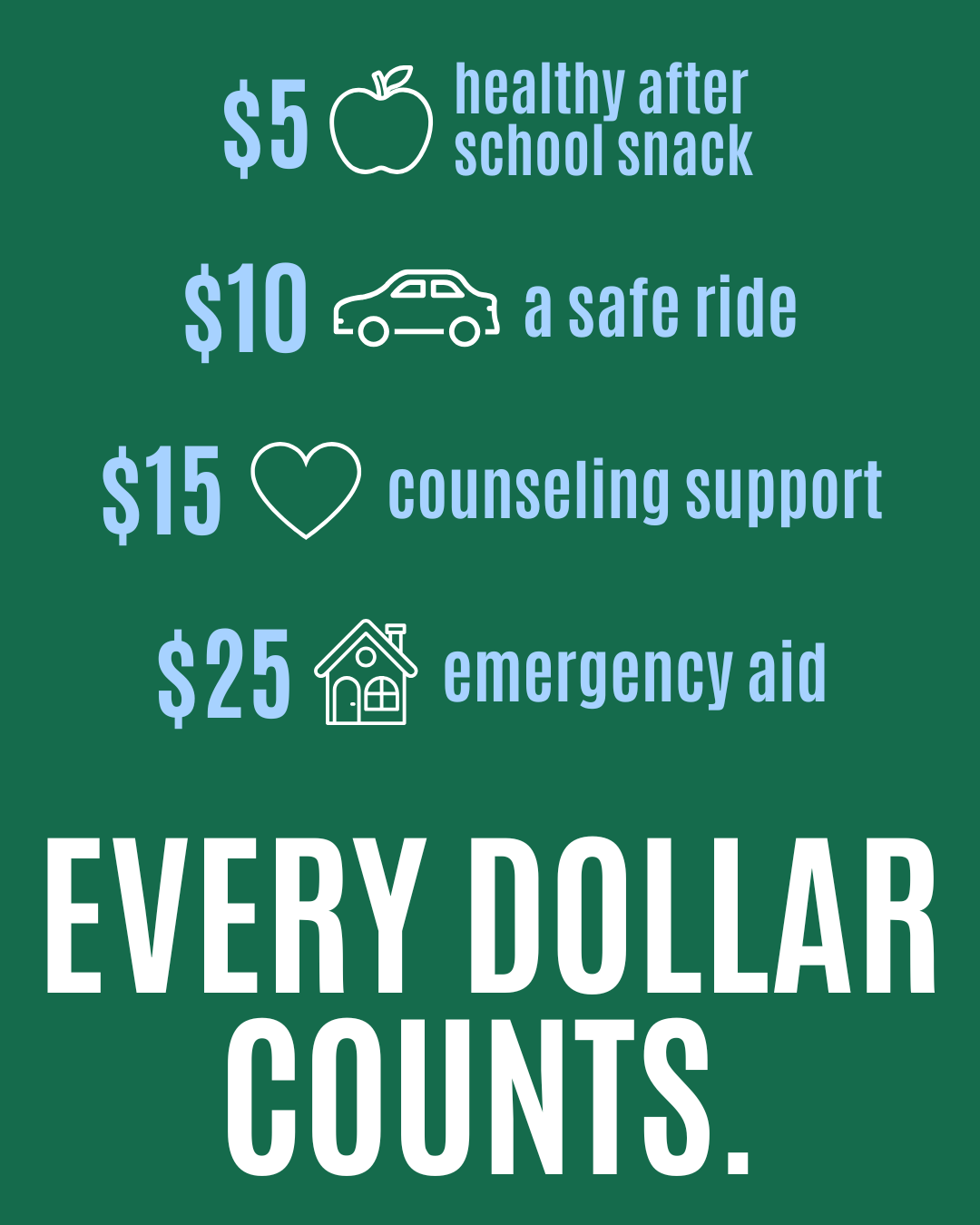
Here in Virginia’s Blue Ridge, $25 can make a difference by:
- Providing healthy snacks for kids in afterschool programs
- Helping cover transportation so families can reach critical services
- Supporting mental health counseling sessions for students
Your gift may feel small to you, but it creates real change when combined with the generosity of neighbors across our region.
But why do we need nonprofits? Why are they called nonprofits?
Nonprofits exist to fill gaps that businesses and government can’t meet on their own—connecting resources, running programs, and helping families thrive.
Unlike businesses, nonprofits don’t generate profits for owners or shareholders. Every dollar brought in goes right back into the mission: serving the community by keeping programs essential to the wellbeing of the community running.
Where Funding for Nonprofits Comes From
To do this work, nonprofits (including United Way of Virginia’s Blue Ridge) rely on a mix of support:
- Grants from government agencies or foundations 3
- Donations from individuals like you
- Corporate support from local businesses
- Events and fundraisers that bring the community together
Why Donations Are Needed Alongside Other Funding
Each funding source has its strengths, but they don’t cover everything on their own. Corporate gifts and events help build momentum and grants often cover the biggest program costs. However, what’s often misunderstood is that grants rarely fund an entire program—just certain pieces—so personal donations step in to keep everything connected. 4
For example:
- A grant might pay for afterschool snacks, but not the transportation that gets kids to the program.
If a child can’t get there safely, the program can’t help them—no matter how many snacks are waiting. Transportation is the bridge between a child and the support they need. - A grant could cover tutoring supplies, but not the counselor who helps kids manage stress.
Books and pencils matter, but so does having a trusted adult who helps a student stay focused and cope with challenges at home or school. Without that counselor, learning is harder. - A grant might fund community health visits, but not the data system that tracks who’s been served.
Tracking matters because donors and communities want to see impact. Without data, we can’t prove what’s working, improve programs, or show accountability. - Some grants even prohibit covering basic overhead—things like utilities, insurance, or the salaries of staff who coordinate and run the program.
Just like any business, nonprofits need lights on, insurance to stay compliant and safe, and skilled staff to manage payroll, fundraising, and outreach. These people aren’t “extra”—they’re what ensure families actually receive the help promised.
This is why personal donations are so important. They are the flexible dollars that tie every funding stream together. They fill the gaps, keep programs running smoothly, and ensure services succeed in practice—not just on paper.
The Power of Collective Giving
When 100 neighbors each give $25, that’s $2,500—enough to provide tutoring, meals, and counseling support for dozens of children. When 1,000 people give, it becomes $25,000 fueling real change right here in Virginia’s Blue Ridge.
And generosity isn’t just good for the community—it’s good for you, too. Research shows that giving is linked to reduced stress, better mental health, and even longer lives56.
Corporate gifts, workplace campaigns, and events bring momentum. Grants provide essential program funding. But the picture isn’t complete without individual donors. Your $25 is what turns plans on paper into real support—a meal after school, a safe ride home, or a child finally feeling seen and supported. Together, these funding streams make sure programs don’t just exist in theory but change lives in practice.
Bottom line: Your gift isn’t small. It’s the missing piece that makes the whole system work.
Sources:
- Fundraising Effectiveness Project — Q1 2025 report showing 57% of donors give $1–$100. AFP Global ↩︎
- Candid — Small-dollar donors (< $5,000 annually) make up over 96% of all nonprofit donors. Candid ↩ ↩︎
- Candid — “How many nonprofits rely on government grants?” Candid.org ↩ ↩︎
- “Grants vs. Donations: What Every NGO Needs to Know.” Funds for NGOs ↩ ↩︎
- Yale School of Management — Insights on donor behavior and collective impact. Yale SOM ↩ ↩︎
- University of Alabama at Birmingham — “How giving to others can boost mental and physical health.” UAB News ↩ ↩︎