
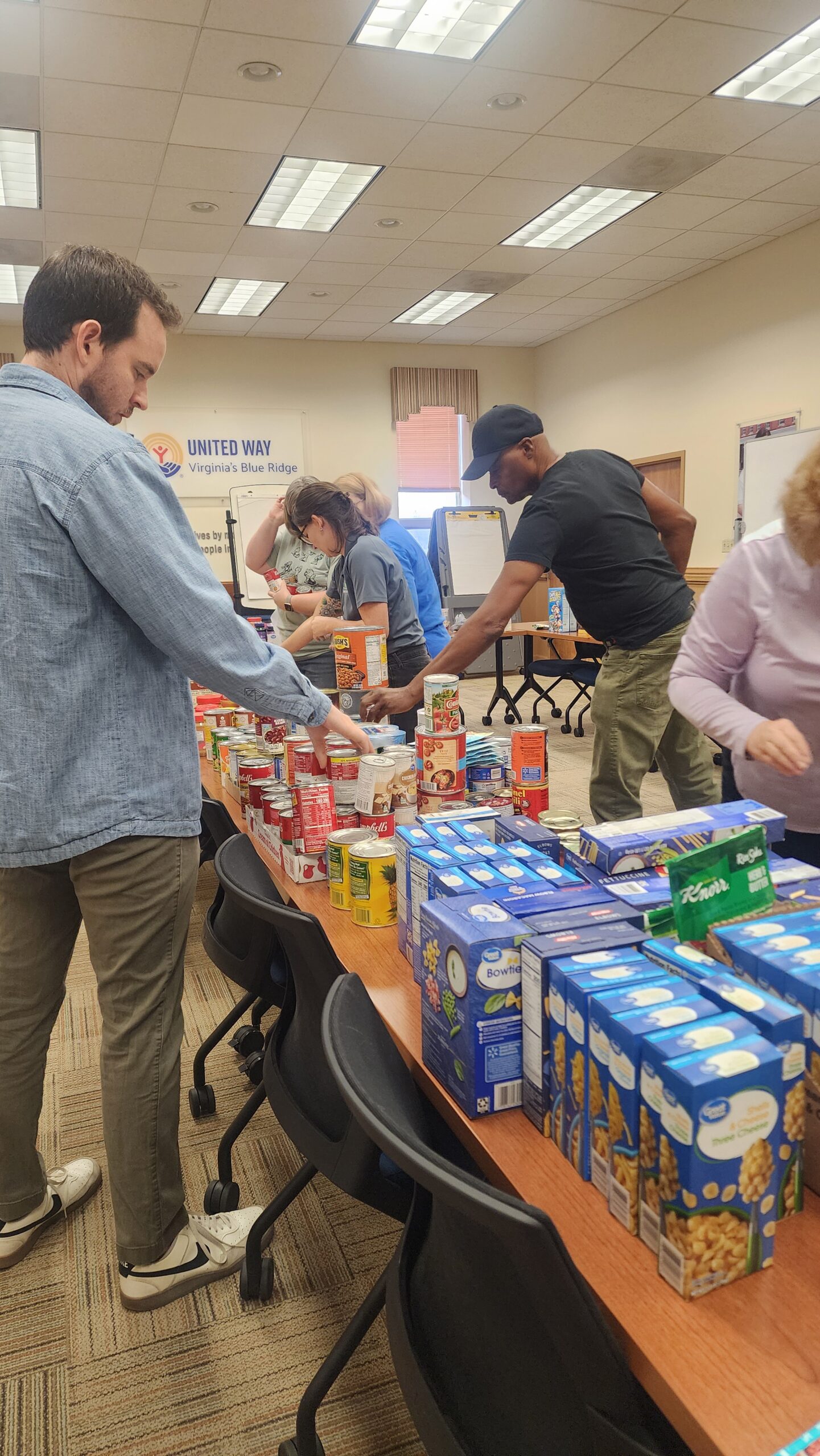
As the holiday season begins, many families in our region are facing rising food costs, reduced benefits, and growing uncertainty. For some, the pantry runs low long before the next paycheck arrives. That’s why community-led efforts like the Western Virginia Water Authority (WVWA) food drive matter. This week, WVWA and UWVBR staff collected and delivered hundreds of food items to United Way, where our team sorted and packed them for distribution. These items will help local households who are struggling to keep meals on the table as winter approaches.
Food drives might seem small, but they’re a powerful example of how neighbors can strengthen community resiliency—especially during the holidays.
Food Insecurity Rises During the Holiday Season
Food insecurity affects millions of Americans year-round, but the need often climbs during the colder months when families face higher heating bills, holiday-related expenses, and limited school-day meal access for children.
According to Feeding America,
- More than 44 million people in the U.S. face food insecurity, including 13 million children. (Feeding America, 2023)
- In Virginia, 1 in 12 people and 1 in 10 children are food insecure. (Feeding America – Virginia Data)
Meanwhile, USDA research shows that families with children experience significantly higher rates of food insecurity—especially single-parent households and families with limited income. (USDA, Household Food Security in the United States, 2022)
During the holiday season, these pressures intensify. Schools close for breaks, SNAP benefits cover less food than ever due to inflation, and winter utility costs force families to make painful tradeoffs.
Food drives fill an immediate and essential gap.
Why Local Action Strengthens Community Resilience
Food drives—whether hosted by businesses, civic groups, or neighborhoods—help stabilize families in several key ways:
1. They keep local shelves full when need spikes.
Food pantries rely heavily on community donations to meet seasonal demand, especially when supply chains tighten or federal assistance programs fall short.
2. They relieve stress on families facing impossible decisions.
When a family receives two bags of groceries, that might mean they can afford to pay rent on time or refill a prescription.
3. They strengthen community bonds.
Research shows that communities with strong social ties and mutual support recover more quickly from crises and maintain better long-term wellbeing. (CDC: Communities in Action – Social Determinants of Health)
4. They inspire broader action.
A single food drive often leads to more volunteerism, more organizational support, and more awareness of local needs.
Small actions ripple into lasting resilience.
How You Can Help Right Now
Food drives are one of the most direct ways to support families, but they are just one piece of the solution.
As winter approaches, more families are struggling with food, housing, transportation, and medical costs. United Way’s Emergency Relief Fund helps provide immediate, local support for families experiencing crisis.
You can help strengthen our community by:
- Donating to the Emergency Relief Fund to provide urgent assistance to local families
- Volunteering with United Way and our community partners.
- Organizing your own workplace or neighborhood food drive
- Sharing this message to raise awareness during a critical season
Together, we can ensure that no family in our region has to face hunger alone—this holiday season or any season.
Sources
- Feeding America. Hunger and Poverty in the United States. https://www.feedingamerica.org/hunger-in-america
- Feeding America. Virginia Hunger Data. https://www.feedingamerica.org/hunger-in-america/virginia
- USDA. Household Food Security in the United States in 2022. https://www.ers.usda.gov/publications/pub-details?pubid=107702
- Centers for Disease Control and Prevention (CDC). Social Determinants of Health: Community and Social Context. https://www.cdc.gov/prepyourhealth/discussionguides/community.htm